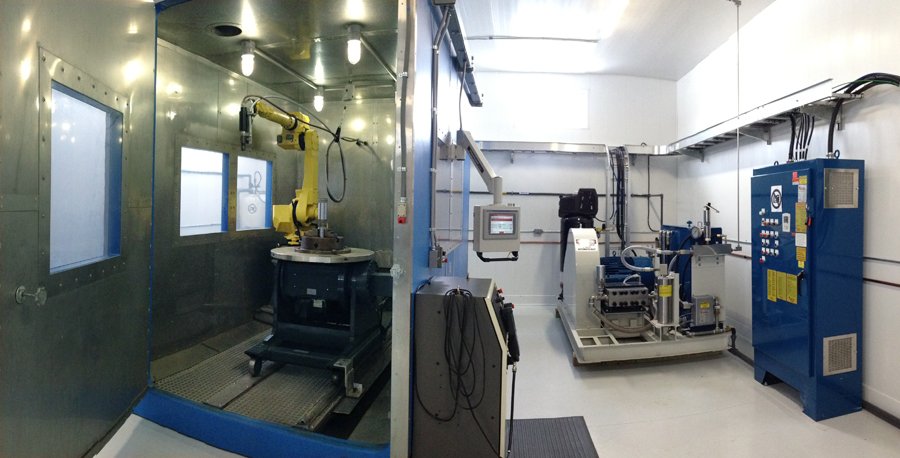
The pulsed waterjet produced by this unique technique is very powerful. It can virtually penetrate or break any material in its path. The machine is quite simple to operate and does not require a high-pressure pump, if any, greater than 5,000 psi (34.5 MPa). The electrical pulsed power system used to produce the jet consists of a capacitor bank to store the electrical energy (like a rechargeable battery), a power unit to charge the bank (battery charger), quick acting ignitron switch and a nozzle. The machine shown in the photograph here is a versatile one, rated to store 100 kJ of electrical energy at the maximum voltage of 22 kV. It is still compact and easily portable. However, for most of the applications illustrated here, the energy required is less than 20 kJ.

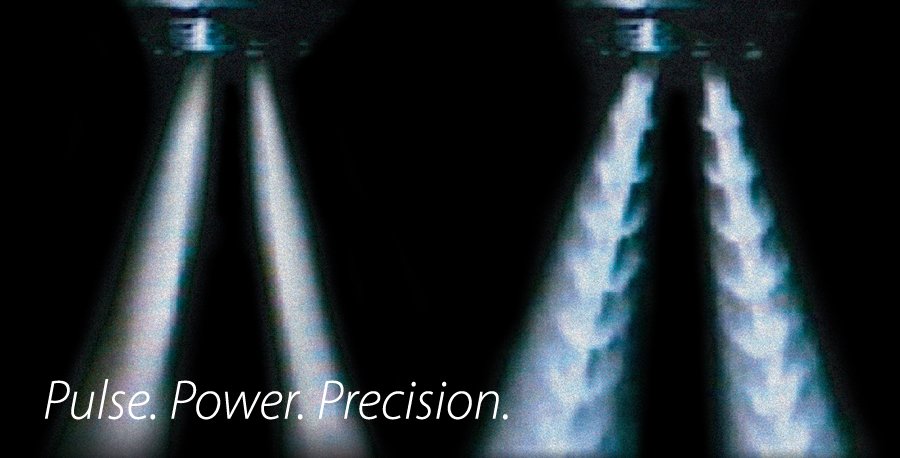
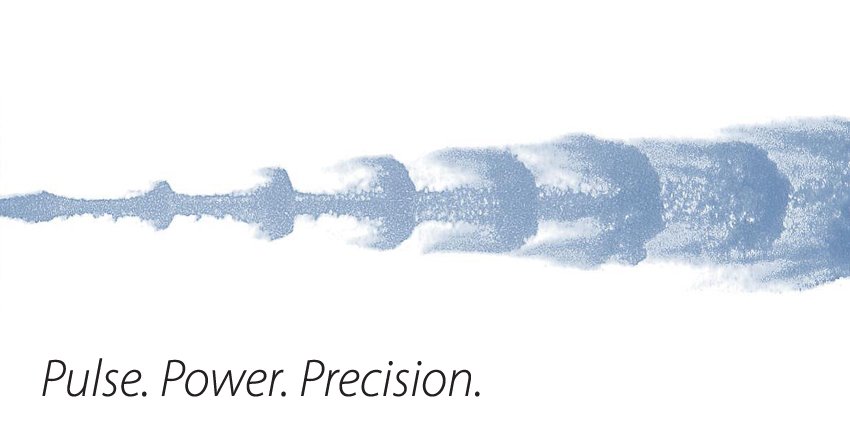
How does it work? Two electrodes are placed in a specially designed nozzle. The nozzle contains either quiescent water or, water flow at low pressure. The capacitors are charged to a required voltage and the electrical energy is then rapidly dumped between the electrodes by the switch. Like a spark produ-ced by the spark plugs in an auto cylinder, an electric arc is formed between the electrodes. This arc gene-rates a very hot steam (plasma) bubble which attains a diameter of about 33,000-ft (10,000-m) in one second. Escaping from the nozzle, this bubble pushes the water in front of it at a very high speed (> 3,000-ft/s), ejecting a pulse of water. When this high-speed pulsed waterjet hits the target, the pressure of impact, as shown in the photograph, is very high. Under such high pressures, the target breaks down into pieces (for more details, refer to the references listed below).

Applications:

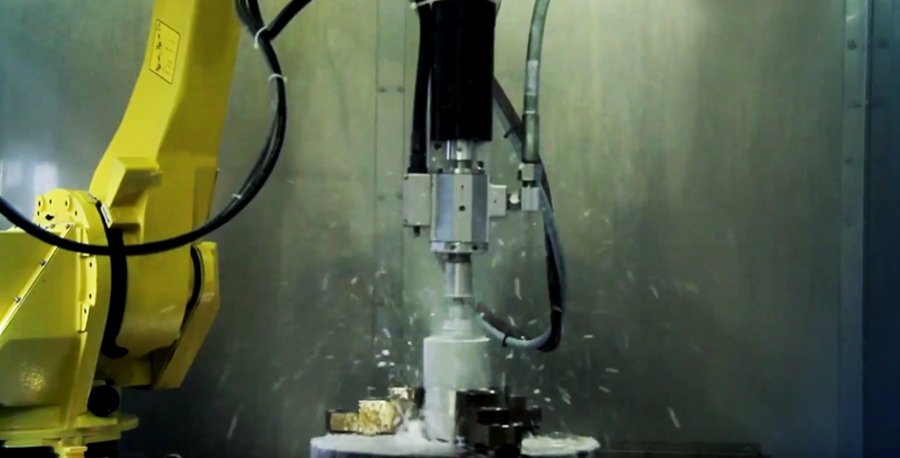
There are many applications to which this unique compact portable machine can be put to good use. The photographs show some of the applications that we have demonstrated to potential end users: Annihilation of explosives by piercing holes, or fragmentation of both plastic and metallic pipes, piercing through metallic sheets, removal of the chemical build-up from the walls of chemical reactor vessels or pipelines, and demolition of concrete structures (not shown). The machine is now under investigation for neutralization of land-mines as it can be placed far away (more than ten metres), and the nozzle (depending upon the amount of water, energy, etc.), about a metre away from the buried mine. Also, as the nozzle is not an integral part of the electrical pulsed power system it can be mounted on a jumbo.


References

  • Vijay, M.M. 1996. Electrodischarge Technique for Producing Powerful Pulsed Water Jets: Potential & Problems. Proc. 13th International Conference on Jet Cutting Technology, pp.195-210. BHR Group, Cranfield, England.
  • Vijay, M.M., et al. 1997. Generation of Powerful Pulsed Waterjets with Electric Discharges: Fundamental Study. Proc. 9th American Water Jet Conference, pp.415-430, Water Jet Technology Association, St. Louis, Missouri, USA.
  • Vijay, M.M., et al. 1999. Modelling of Flow Modulation Following the Electrical Discharge in a Nozzle. Proc. 10th American Water Jet Conference, pp.105-115, Water Jet Technology Association, St. Louis, USA.