|
Figure 1(A) shows the damage to lead sample exposed to a regular (plain) waterjet. In Fig. 1(B), the sample is exposed to the same jet, except now it is fully submerged in a tank of water. The damage to the sample is phenomenal. One may ask why this is so? The answer is quite simple. In the 2nd case, the waterjet cavitates due to the high turbulence in its vicinity (usually called ‘mixing layers'). In fact, if a regular waterblast nozzle is not designed properly, cavitation may occur right inside the nozzle and destroy it within few seconds (for details, see Ref. 1 listed below). If used properly, cavitation can enhance the performance of a regular waterjet.
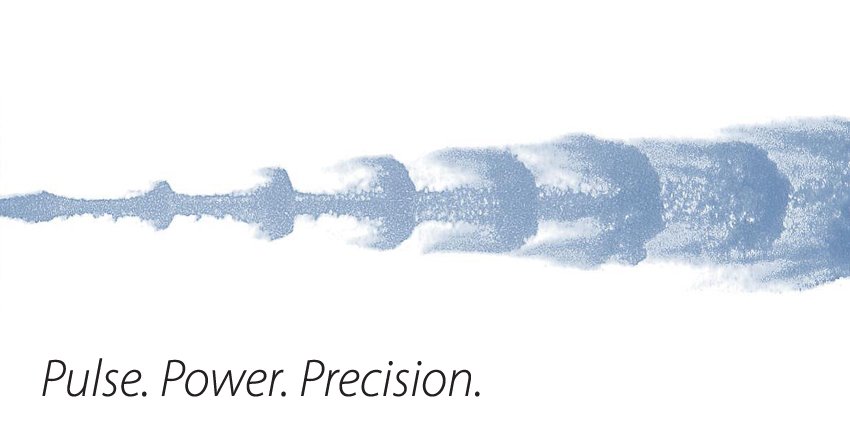
So, what is cavitation and how does it work to improve the performance of a regular jet? Defined simply, cavitation is the formation of air or water vapor bubbles in the flow field when the dynamic pressure changes rapidly. Air bubbles, however, are not effective in enhancing the jet performance. When the pressure falls below the vapor pressure, the water flashes into vapor (usually thought of as cold boiling) and forms bubbles. A sequence of photographs taken with a pulsed laser light is shown in Fig. 2. (Ref. 2). Since the bubbles form around the jet, initially the cluster appears like a donut. Later as the jet spreads in the water, the entire cross-section is filled with bubbles {Figs. 2(C) & (D)}. While Fig. 2 (E) clearly shows the bubbles, Fig. 2(F) shows only air bubbles. When these bubbles reach the target, the jet pressure increases (stagnation pressure) and the bubbles immediately start to disappear (this is called ‘collapse' or implosion). Experimental and theoretical considerations have shown that when this happens, very high-speed jets (called ‘microjets') are formed on the target at the point of collapse. The net result is the impact pressure increases as indicated by the following equations (Ref. 1):
The collapse pressures vary from 1000 MPa 145,000 psi(1000 MPa) to almost 1,450,000 psi (10,000 MPa)!. This variation is due to the uncertainty in the value of in Eq. (1), which is constant and depends on the quality of water (that is, the amount of air in it). Remember, however, that these pressures are highly localized and act only for a short period of time. Improvement in performance depends on the intensity of cavitation (that is, frequency of collapse) which is related to a parameter called the cavitation number. Cavitation number is function of the ambient pressure (that is, the pressure in the tank = Pa) and the pressure drop across the nozzle [ ; for more details see Ref. 1)]. Cavitation intensifies when the ambient pressure is reduced or the pump pressure is increased.
There are some serious drawbacks with cavitating waterjet nozzles. First, they are only effective under fully submerged situations (for example, cleaning the hull of a ship in wet dock). Second, the performance is very sensitive to standoff distance. This is shown in Fig. 3 where mass loss sustained by samples of aluminum is used as a measure of performance. The peak performance at S/d = 15 (S = standoff, d = nozzle diameter) should be noted. These drawbacks can be overcome by the proper designing of nozzles (Ref. 2).
VLN Tech offers several types of cavitating nozzles, the most advanced one being the so-called ‘reverseflow' cavitating nozzle (Refs. 3 and 4). This nozzle not only functions better under fully submerged environment, it also works in air. Briefly, this nozzle consists of a central main high- speed jet surrounded by a stream flowing in the reverse direction. Both flows are taken from the same pump. This causes very severe turbulence in the interface between the two streams. As stated before, this turbulence is the source of cavitation. Extensive data are reported in Refs. 3 & 4. The nozzle is shown on the inside cover of this brochure. The data. and the general views of the samples from which the paints were removed, clearly show that this nozzle performs much better than a conventional waterblast nozzle. Improvement in the standoff distance must also be noted. The nozzle can be custom designed for any application.
References
- Vijay, M.M. 2001. Fluid Mechanics of Jets. Section 2.0 in Fluid Jet Technology - Fundamentals and Applications, Water Jet Technology Association, St. Louis, USA.
- Vijay, M.M., et al. 1990. A Study of the Characteristics of Cavitating Water Jets by Photography and Erosion. Proc. 10th International Symposium on Jetting Technology, pp.37-68, BHR Group, Cranfield, England.
- Vijay, M.M., et al. 1996. Study of Novel Nozzle Device for Generating Cavitating and Pulsed Waterjets. Proc. 13th International Symposium on Jetting Technology, pp.3-12, BHR Group, Cranfield, England.
- Vijay, M.M., et al. 2000. Reverse Flow Nozzle for Generating Natural Cavitating or Pulsed Waterjets: Basic Study and Applications. Proc. 15th International Symposium on Jetting Technology, pp.243-252, BHR Group, Cranfield, England.
|