How Does a Pulsed Waterjet Work?

Production of High-Frequency Forced Pulsed Waterjet

  • There are several techniques for producing natural and forced pulsed waterjets.

  • Natural Pulsed Waterjets: a continuous waterjet emerging in air breaks up into droplets due to aerodynamic drag at some distance from the nozzle. These droplets are considered to be natural pulsed waterjets and are used for some simple industrial cleaning applications (e.g. the fanjet). These types of waterjets are not effective for cutting (e.g. rocks) or for the removal of hard coatings.

  • Forced Pulsed Waterjet Machines: the mechanism of forced break-up (that is, modulation) of a continuous jet is rather different. In the FORCED PULSED WATERJET MACHINES manufactured by VLN Inc., ultrasonic waves are used to modulate a continuous stream of water to generate pulsed waterjets.

Jet Impact on a Material Target

When a steady continuous waterjet impinges normally on any surface to be cut or cleaned, the maximum pressure at the point of impact is called the stagnation pressure ps, given by:

Where V0 = speed of the jet and = density of water. V0 is proportional to P, the static pressure at the nozzle inlet (pump pressure) - (frictional losses). However, if a drop or a slug of water strikes the same surface, the initial impact pressure will be much higher. This is the waterhammer pressure given by:

Where C0 = speed of sound in water = 1524 m/s (5,000 ft/s).

The time during which the waterhammer pressure acts is:

(d = nozzle diameter)

From Eqs. (1) and (2), it is clear that the amplification of pressure on the surface is:

For example:

ps (psi) 5,000 7,500 10,000 12,500 15,000 17,500 20,000
BAR 350 bar 500 bar 700 bar 860 bar 1,030 bar 1,200 bar 1,380 bar
(MPa) 34.5 52.2 69.0 86.2 103.5 121.0 138.0
M 11.6 9.5 8.2 7.3 6.7 6.2 5.8

That is, for example, when the pump is set to operate at 69 MPa, the waterhammer pressure on the target would be 566 MPa (82,000 psi!). Since the behavior of the material depends on the impact pressure and time (determined by the frequency and the nozzle diameter), significant improvement in cutting/cleaning performance can be expected with the use of pulsed waterjets. The examples illustrated below confirm these basic theoretical observations (extensive details are given in the references listed).

Production of High-Frequency Forced Pulsed Waterjet

As described in detail by Vijay (Ref. 1), there are several techniques for producing natural and forced pulsed waterjets. It is quite simple to produce natural pulsed waterjets. In fact, a continuous waterjet emerging in air breaks up into droplets due to aerodynamic drag at some distance from the nozzle. These droplets are considered to be natural pulsed waterjets and are used for some simple industrial cleaning applications (the so-called fanjet is an example). However, they are not effective for cutting (for example, rocks) or, the removal of hard coatings.

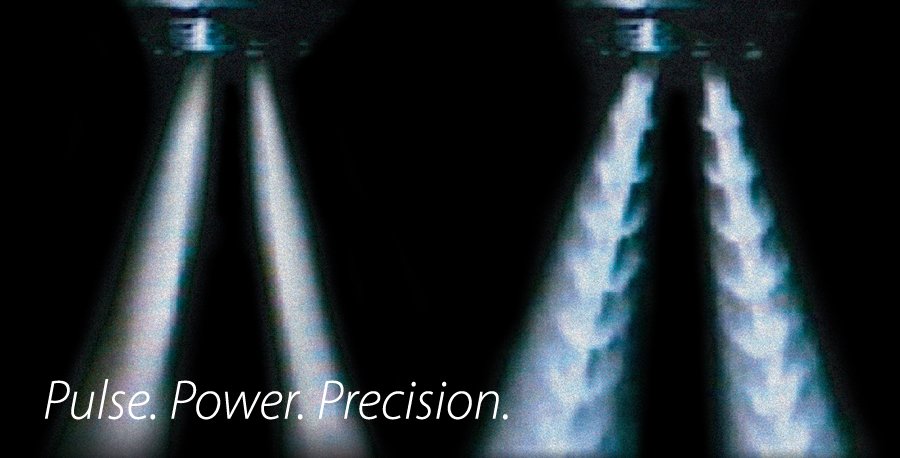
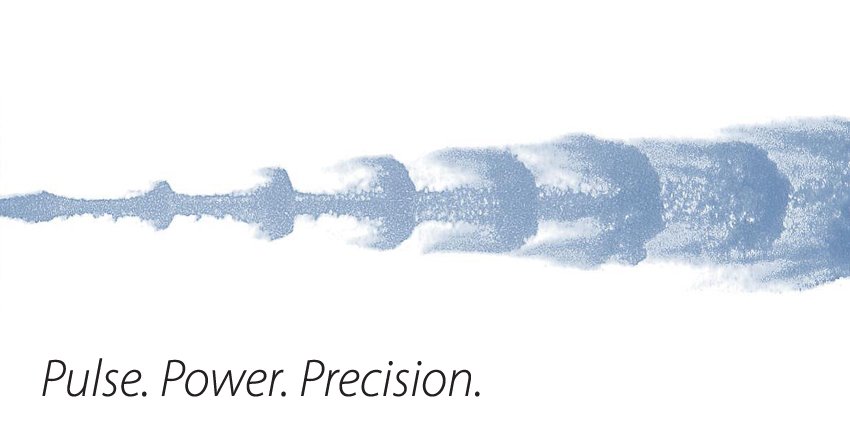
The mechanism of forced break-up (that is, modulation) of a continuous jet is rather different. In the FORCED PULSED WATERJET MACHINES manufactured by VLN, ultrasonic waves are used to modulate a continuous stream of water to generate pulsed waterjets (Refs. 2 to 10). The method used, the mechanism of formation and, the typical appearance of a pulsed jet are shown in Figs. 1, 2 and 3 respectively.

The oscillating tip (Fig. 1) inside the nozzle is attached to an ultrasonic piezoelectric transducer (which contracts and expands due to an applied electric field) or, a magnetostrictive transducer (which contracts and expands due to an applied magnetic field). These oscillations influence the velocity of the stream causing it to break up at some distance from the nozzle (called the break-up length = lo, as indicated in Fig. 2). Close to the nozzle (S´ 10-100dt, depending on the operating conditions), the jet remains continuous. Between S´ and lo, the jet is in a transition mode (that is, pulses start to form). Beyond lo and, just before the jet disintegrates into small droplets, well-defined large pulses are formed as shown in both Figs. 2 and 3. All the geometric factors listed in Fig. 1 influence the shape of the pulses and hence their performance (for details, refer to Refs. 2 to 7). However, the machines manufactured by VLN are designed for optimum and highly reliable performance by thorough testing before delivery.

To clarify their intensity, results obtained by cutting discs of copper with the forced-pulsed and the corresponding continuous waterjet are depicted in Fig. 4. Rate of mass loss is a measure of performance. Superior performance by the pulsed waterjet is absolutely clear. Figure 5 emphasizes this fact even more. Figure 4 also supports the observations made above: (i) for standoff distances (S) < lo { 100 mm (4 in); see also Fig. 2}, the jet does indeed remain continuous and therefore no mass loss occurs, (ii) at standoff distances between 100 to 120 mm, pulses start to form and the mass loss begins to increase, (iii) optimum performance occurs at standoff distances between 120 to 150 mm (in the region of well-formed pulses, Fig. 3) and (iv) it gradually decreases as the pulses begin to disintegrate into droplets. Thus the standoff distance plays a major role and, for a particular application, can be controlled by setting appropriate values for geometric (for example, ‘a in Fig. 1), ultrasonic (frequency and amplitude), and water parameters.

Examples of Industrial Applications

Forced pulsed waterjets can be used beneficially for cutting of metals (Ref. 6), fragmenting & slotting of rocks (Ref. 9), removal of hard coatings (Refs. 2, 8 & 10), deburring (see Fig. 7), peening and many other applications. The emphasis in this technical note, however, is on the removal of hard coatings. Since the pump pressure is generally 10,000 psi (69 MPa), the machines are compact in size, readily portable, simple and safe to operate. Figure 6 shows the performance of our waterjet machine at 5,000 psi (34.5 MPa) with an ultra-high pressure (36,000 psi = 248 MPa) waterjet system, both rated to operate at the same hydraulic power (26.8 hp = 20 kW). The results obtained with the pulsed jet are not surprising! At standoff distances of practical interest, the area removal rate achieved with the pulsed waterjet machine is almost 2.5 times that of the ultra-high pressure system. With the machine manufactured for the Department of National Defence of Canada, using a single jet (parallel passes) at about 5,000 psi (34.5 MPa) and hydraulic power of only 25 hp (18.6 kW), we have achieved, depending on the type of coating, removal rates from 25 to 100 ft2/hr (2.32 to 9.3 m2/hr). It would be possible to double these rates with a simple dual or triple-orifice stationary nozzle. Or, as discussed below, using a self-rotating multiple-orifice nozzle at 6,000 -10,000 psi (41 - 69 MPa), it would be possible to increase the removal rates to almost 400 ft2/hr (37.2 m2/hr) and striations would not occur.

Self-Rotating Forced Pulsed Waterjet System

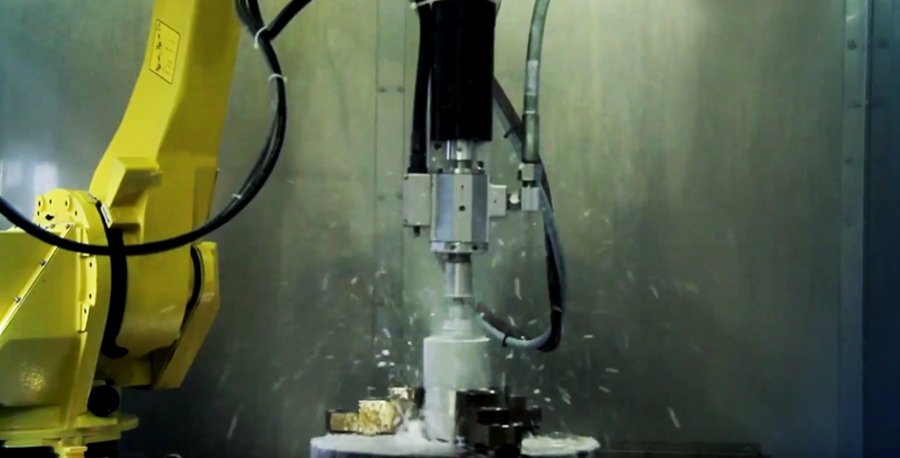
General views of our first generation of the gun consisting of a transducer, a swivel and a rotating nozzle-head are shown in Figs. 8 and 9. The nozzle-head consists of four jets. The outer two jets make the nozzle to rotate at almost 3,000 rpm. The two inner jets are the main pulsed waterjets that do the required job. We have tested the system extensively using it for removing the heavy rust formed on structural parts (Fig. 9) and several different types of multi-layered coatings. Photographs of the samples treated with the rotating nozzle system are shown on the next two pages. All these tests were conducted at 10.000 psi (69 MPa). It is quite clear that the rate of removal depends on the type of coating. It varies from 7.1 ft2/hr (0.66 m2/hr; according to the navy, this ultra-hard coating is used on super structures of the ship) to 275 ft2/hr (25.5 m2/hr).


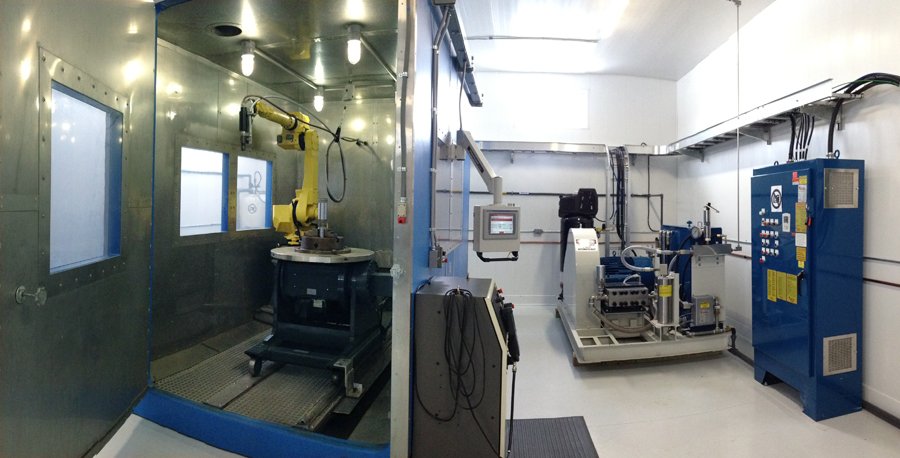
Our forced pulsed waterjet machines have another great advantage. One can operate them in two modes. That is, if the ultrasonic power is turned off, the machine will work as a conventional waterblaster. This will be useful for regular blasting jobs or, the removal of soft coatings. If hard coatings are encountered, activating the ultrasonic generator will do the job. All these features will be fully and clearly explained in the operating and instruction manuals. Copies of technical papers including a video tape of the operation of the machine are available. In-plant demonstration of the machine can be arranged at the cost of the customer.

References

  1. Vijay, M.M. 1998. Pulsed jets: Fundamentals and applications. Proc. 5th Pacific Rim International Conference on Water Jet Technology. pp. 9-23. WJTSJ, Tokyo, Japan & ISWJT, Ottawa, Canada.
  2. Vijay, M.M. 1998. Design and development of a prototype pulsed water jet machine for the removal of hard coatings. Proc. 14th International Conference on Jetting Technology. pp.39-57. BHR Group Conference Series, Cranfield, Bedford, England.
  3. Vijay, M. M. 1992. Ultrasonically generated cavitating or interrupted jet. U. S. Patent No. 5,154,347.
  4. Vijay, M.M., J. Foldyna & J. Remisz 1993. Ultrasonic Modulation of High-Speed Water Jets. pp. 327- 332. Proc. International Conference Geomechanics 93. Rotterdam, Balkema.
  5. Vijay, M.M., & J. Foldyna 1994. Ultrasonically modulated pulsed jets: basic study. Proc. 12th International Conference on Jet Cutting Technology. pp.15-36. BHR Group Conference Series, Publication No. 13, Cranfield, Bedford, England.
  6. Foldyna, J., & M.M. Vijay 1994. Potential of ultrasonically modulated pulsed water jets for cutting metals. Manufacturing Science & Engineering, ASME 1994. Vol.1., PED-Vol. 68-1, pp. 397-404, ASME, New York, USA.
  7. Vijay, M.M., M. Jiang & M. Lai 1995. Computational fluid dynamic analysis and visualization of high frequency pulsed water jets. Proc. 8th American Water Jet Conference. pp.557-572. WJTA (Water Jet Technology Association), St. Louis, USA.
  8. Vijay, M.M., E. Debs, N. Paquette, R. Puchala & M. Bielawski 1997. Removal of coatings with low pressure pulsed water jets. Proc. 9th American Water Jet Conference. pp.563-580. WJTA (Water Jet Technology Association), St. Louis, USA.
  9. Vijay, M.M., J. Remisz, J. Foldyna & P.E. Grattan-Bellew 1998. Preweakening of hard rocks with ultrasonically generated pulsed water jets. Proc. 5th Pacific Rim International Conference on Water Jet Technology. pp. 479-496. WJTSJ, Tokyo, Japan & ISWJT, Ottawa, Canada.
  10. Vijay, M.M., W. Yan, A. Tieu & C. Bai 1999. Removal of hard coatings from the interior of ships using pulsed waterjets: Results of field trials. Proc. 10th American Water Jet Conference. pp.677-694. WJTA (Water Jet Technology Association), St. Louis, USA.